Creating a CSV file in C# is straightforward with IronXL. Simply use the WorkBook.Load() method to open your Excel file, then call SaveAsCsv() to export it as CSV format with your preferred delimiter. This approach eliminates the need for Microsoft Office Interop and provides a robust solution for converting spreadsheet file types in your .NET applications.
How Do I Create a CSV File Using C#?
- Add IronXL Package
- Load existing
WorkBook and save as CSV File
Step 1
How Do I Add the IronXL Package to My Project?
First, you'll need to install IronXL. You've got several options to choose from. You can download it directly: https://ironsoftware.com/csharp/excel/docs/
Or you can import the IronXL NuGet package by following the next few steps. The great news is that IronXL works seamlessly with all .NET environments, including .NET MAUI, Blazor, and can be deployed to AWS, Azure, or Docker environments.
Which Installation Method Should I Choose?
For most developers, the NuGet Package Manager provides the simplest installation method:
- Right-click on the Solution in the Solution Explorer
- Click Manage NuGet Packages
- Browse for IronXL.Excel
- Click Install
This method ensures all dependencies are properly resolved and you're using the latest stable version. The IronXL library supports Linux and macOS in addition to Windows, making it ideal for cross-platform development.
Can I Install Via Package Manager Console?
If you prefer command-line tools or need to automate installations, the Package Manager Console offers a quick alternative:
# Install IronXL via the NuGet Package Manager Console
Install-Package IronXL.Excel
# Install IronXL via the NuGet Package Manager Console
Install-Package IronXL.Excel
SHELL
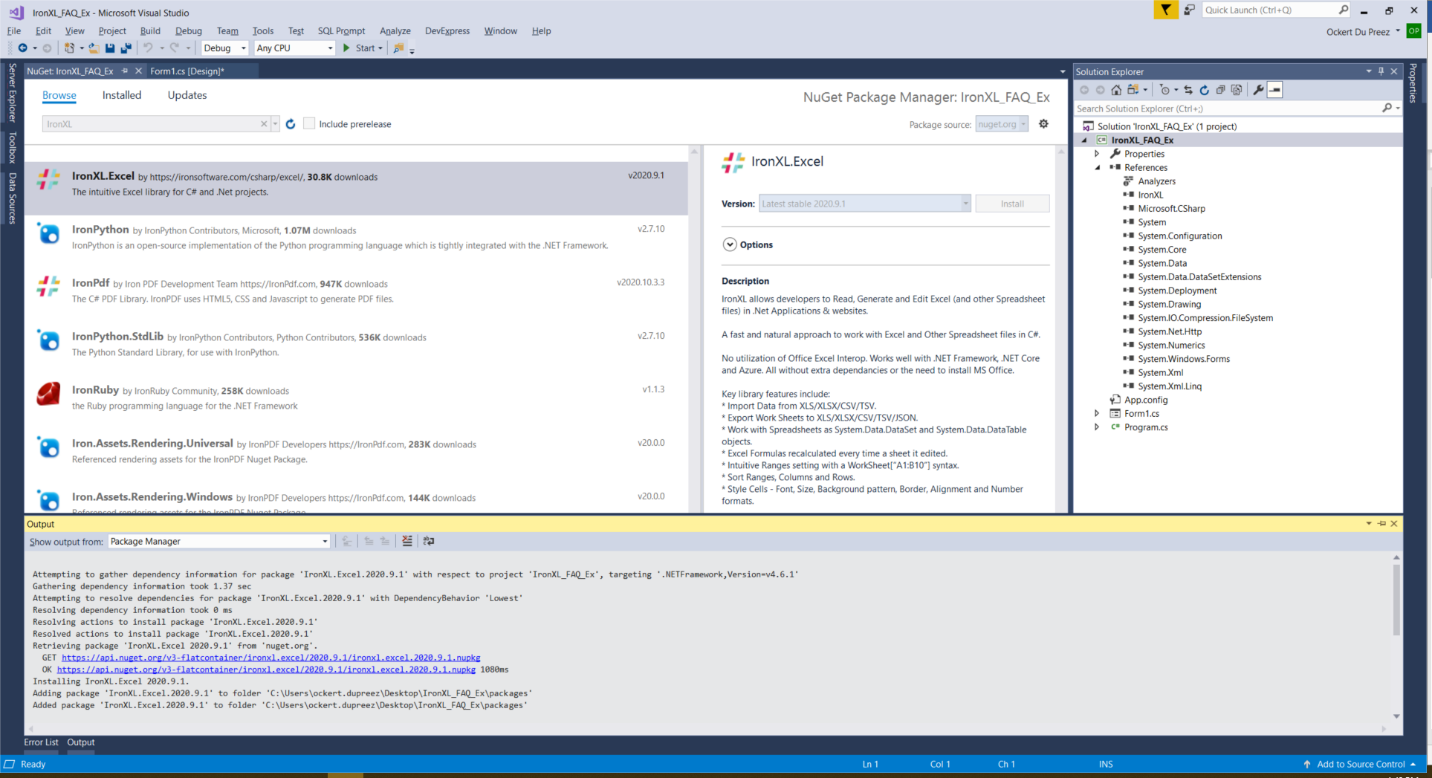 IronXL.Excel NuGet Package
After installation, don't forget to apply your license key to remove watermarks and unlock all features. You can configure licensing in your application startup or through Web.config settings.
How to Tutorial
How Do I Save an Excel Workbook as CSV?
It's really that simple!
Converting Excel files to CSV format using IronXL is refreshingly straightforward and requires minimal code. Unlike traditional approaches that need complex parsing or manual string building, IronXL handles all the formatting and delimiter considerations automatically. This makes it perfect for scenarios where you need to export Excel spreadsheets or convert XLSX to CSV as part of your data processing pipeline.
What Does the Code Look Like?
Here's the code for this simple project. This code loads an existing Excel Workbook and then saves it in CSV format using the SaveAsCsv method.
The original Excel workbook contains the following data:

// Import the IronXL library
using IronXL;

class Program
{
    static void Main()
    {
        // Load an existing workbook
        WorkBook wb = WorkBook.Load("Normal_Excel_File.xlsx"); // You can import .xls, .csv, or .tsv files

        // Save the workbook to a CSV file. This will save the first worksheet as a CSV.
        wb.SaveAsCsv("SaveAsCSV.csv", ","); // This will output: SaveAsCSV.Sheet1.csv

        // Alternative: Save a specific worksheet as CSV
        WorkSheet sheet = wb.GetWorkSheet("Sheet1");
        sheet.SaveAsCsv("SpecificSheet.csv", ",");

        // You can also use different delimiters
        wb.SaveAsCsv("TabDelimited.csv", "\t"); // Tab-delimited
        wb.SaveAsCsv("PipeDelimited.csv", "|"); // Pipe-delimited
    }
}
// Import the IronXL library
using IronXL;

class Program
{
    static void Main()
    {
        // Load an existing workbook
        WorkBook wb = WorkBook.Load("Normal_Excel_File.xlsx"); // You can import .xls, .csv, or .tsv files

        // Save the workbook to a CSV file. This will save the first worksheet as a CSV.
        wb.SaveAsCsv("SaveAsCSV.csv", ","); // This will output: SaveAsCSV.Sheet1.csv

        // Alternative: Save a specific worksheet as CSV
        WorkSheet sheet = wb.GetWorkSheet("Sheet1");
        sheet.SaveAsCsv("SpecificSheet.csv", ",");

        // You can also use different delimiters
        wb.SaveAsCsv("TabDelimited.csv", "\t"); // Tab-delimited
        wb.SaveAsCsv("PipeDelimited.csv", "|"); // Pipe-delimited
    }
}
' Import the IronXL library
Imports IronXL
Module Program
Sub Main()
' Load an existing workbook
Dim wb As WorkBook = WorkBook.Load("Normal_Excel_File.xlsx") ' You can import .xls, .csv, or .tsv files
' Save the workbook to a CSV file. This will save the first worksheet as a CSV.
wb.SaveAsCsv("SaveAsCSV.csv", ",") ' This will output: SaveAsCSV.Sheet1.csv
' Alternative: Save a specific worksheet as CSV
Dim sheet As WorkSheet = wb.GetWorkSheet("Sheet1")
sheet.SaveAsCsv("SpecificSheet.csv", ",")
' You can also use different delimiters
wb.SaveAsCsv("TabDelimited.csv", vbTab) ' Tab-delimited
wb.SaveAsCsv("PipeDelimited.csv", "|") ' Pipe-delimited
End Sub
End Module
' Import the IronXL library
Imports IronXL

Module Program
    Sub Main()
        ' Load an existing workbook
        Dim wb As WorkBook = WorkBook.Load("Normal_Excel_File.xlsx") ' You can import .xls, .csv, or .tsv files

        ' Save the workbook to a CSV file. This will save the first worksheet as a CSV.
        wb.SaveAsCsv("SaveAsCSV.csv", ",") ' This will output: SaveAsCSV.Sheet1.csv

        ' Alternative: Save a specific worksheet as CSV
        Dim sheet As WorkSheet = wb.GetWorkSheet("Sheet1")
        sheet.SaveAsCsv("SpecificSheet.csv", ",")

        ' You can also use different delimiters
        wb.SaveAsCsv("TabDelimited.csv", vbTab) ' Tab-delimited
        wb.SaveAsCsv("PipeDelimited.csv", "|") ' Pipe-delimited
    End Sub
End Module
The SaveAsCsv method provides flexibility in choosing your delimiter, which is particularly useful when dealing with data that might contain commas. You can also read CSV files back into Excel format or write to CSV files directly without needing an intermediate Excel file.
For more advanced scenarios, you might want to convert a DataTable to CSV or work with Excel to SQL conversions using IronXL's comprehensive data handling capabilities.
What Additional Features Does IronXL Provide?
The IronXL Excel library also provides these powerful features:
- Comprehensive data handling including manipulation, export, and import capabilities. You can import Excel data from various formats and load Excel from SQL databases.
- Full Excel-compatible chart management. You can create Excel charts and edit charts programmatically.
- Support for Excel's most popular formats (.xlsx) and other file formats. This includes Excel to HTML conversion and JSON/XML format support.
- Rich cell formatting including text alignment, font size, and color, background patterns, and Excel number formats. Apply conditional formatting and style cells, borders, and fonts.
- Control over Excel display settings like gridlines. Additional features include freeze panes, autosize rows and columns, and Excel print setup.
Advanced CSV Operations
When working with CSV files, you may encounter scenarios requiring more sophisticated handling:
Working with Large Files: IronXL efficiently handles large CSV files without loading everything into memory. The library's performance optimizations ensure smooth processing even with file size limits.
Data Validation: Before converting to CSV, you can sort cells, trim cell ranges, or apply data validation to ensure data integrity.
Formula Evaluation: IronXL evaluates formulas before exporting to CSV, ensuring calculated values are properly exported. The library supports math functions and Excel formulas in C#.
Secure Export: For sensitive data, you can encrypt workbooks with passwords before processing or apply worksheet-level protection.
Library Quick Access
IronXL API Reference Documentation
Learn more and share how to merge, unmerge, and work with cells in Excel spreadsheets using the handy IronXL API Reference Documentation.
IronXL API Reference Documentation