LeadByExample(): Kate Kirwin on Building Opportunity, Backing Yourself, and Shifting Tech From Fear to Possibility
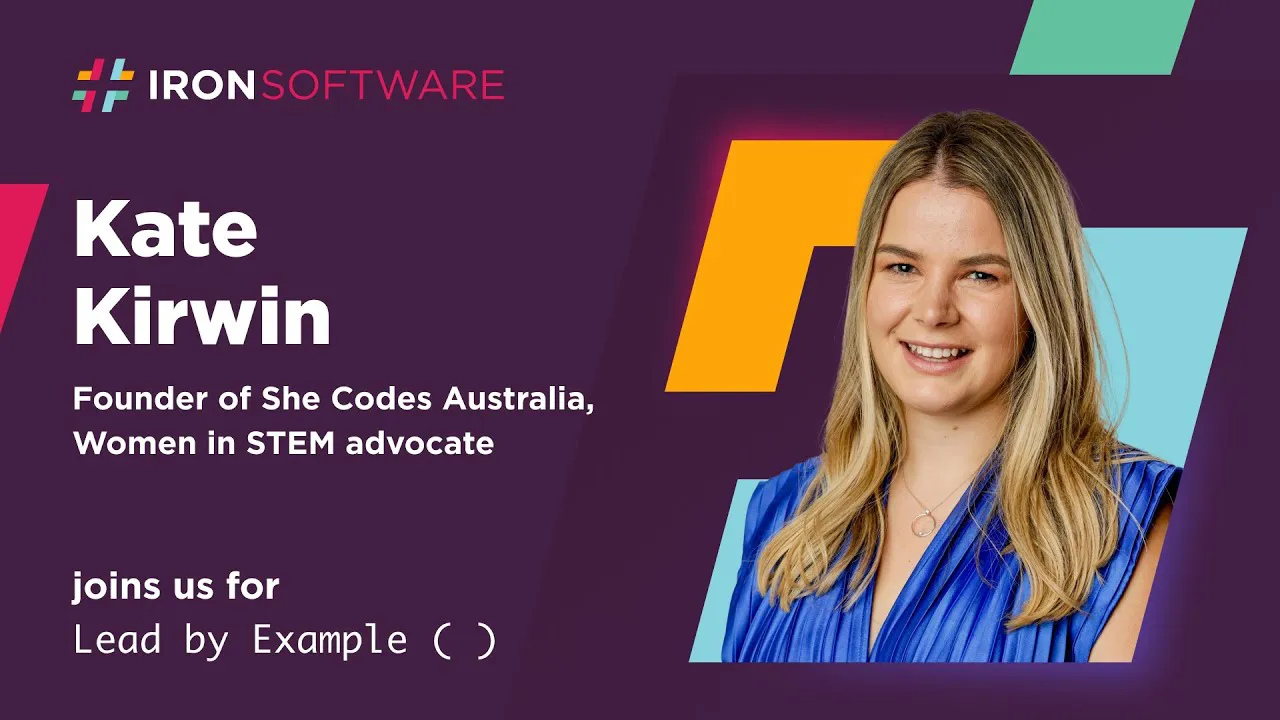
Kate Kirwin founded She Codes Australia at 21. A decade later, more than 7,000 women have learned to code through her programs, and she's been named WA Young Australian of the Year. She describes herself as a passionate supporter of women in STEM, a 'super connector' and a hula hooper who loves glitter.
Her career started early: she entered corporate environments at 17, moved into large-scale events and community building, and managed charity events for up to 1,000 participants as an Event Coordinator at Multiple Sclerosis WA. She later joined Spacecubed, immersing herself in the startup ecosystem before launching “She Codes”. Her work continues to spotlight the barriers women face in STEM and what it takes to dismantle them.
Kate is proof that leadership can start before mastery that it begins with curiosity, humility, and consistency. That's why she belongs in this series.
LeadByExample() looks beyond titles to focus on the thinking and actions that define leadership. It's about how credible technologists lead through judgment, responsibility, and action. We've featured Scott Hanselman on ethical stewardship. Matt Goldman on shipping under real constraints. Jakub Chodounsky on thinking critically instead of cargo-culting. Each guest demonstrates that leadership shows up in how you think, decide, and treat responsibility.
In this episode, Kate shares what building “She Codes” actually looks like: measuring impact in real numbers, navigating the invisible pressure women carry around worth and pricing, embracing the 'done is better than perfect' moments that define founder life, and staying curious as AI rewrites the rules.
Why Kate Belongs in This Series
Kate isn't a senior engineer. She'll tell you herself: she's not a software developer, and the people who teach in her programs are better developers than she is. Earlier in her career, that triggered imposter syndrome. "What if people find out that I'm not the best software developer in the world? What if they think badly of me for that?"
Now she sees it differently. That honesty is exactly why she fits. LeadByExample() is a credibility filter, not a celebrity showcase. We feature people who demonstrate substance over status, thinking over trend-following, responsibility over ego. Kate embodies all of that, while proving that example-setting isn't hierarchical.
She builds capability, confidence, and access at scale. She learns in public. She's approachable without being performative. And she offers a narrative many teams need right now: the future of work isn't something to fear. It's something we can learn our way into.
What You'll Learn From Kate
1. Impact Is Not a Vibe, It's a Number You Track
Kate shares an ambitious goal: impacting 100,000 women by the end of 2025.
In their most recent impact report (completed around August 2024), “She Codes” estimated their reach at about 63,000 people across a decade of programs, events, webinars, and community initiatives. With new numbers still being finalized, Kate believes they're 'vanishingly close' to that 100,000 target.
The origin of the goal reveals her approach. Kate and her team studied Australia's projected tech talent needs, once estimated at 200,000 people by 2025 and asked a simple question: "Wouldn't that be amazing if half of the people coming into tech were women?"
Even if the industry hasn't fully matched that ideal, Kate is clear-eyed about progress. It's happening, but it needs to happen across every level, from young women in school to mid-career professionals navigating AI and career pivots.
2. Representation Works Even When It's Unpolished
One of Kate's most powerful stories involves an alum who wanted to pursue STEM in high school but was discouraged by a well-meaning professor. He told her she was too 'chatty' and outgoing to belong in science. She didn't pursue it.
Years later, meeting Kate and other women in the community flipped that narrative.
"Oh, wait, hang on. Kate's fun. Kate's loud. Kate's chatty. I could do that."
That alum learned to code, took time off to have her first child, and now works as a software developer. Kate returns to this theme often: the barrier isn't just skills. It's identity. It's whether someone can see themselves as belonging.
This is leadership without polish and it works precisely because it's unpolished. Kate didn't need to be the most technically impressive person in the room. She needed to be visible, consistent, and real.
3. Confidence and Financial Security Are Technical Outcomes Too
Kate doesn't treat 'learning to code' as the finish line. She talks about what comes after: women moving from insecure casual work into stable tech careers, gaining financial security, buying homes, fundamentally changing their circumstances.
"We're not just building community and confidence and skills. It's also these fundamental parts of life that we're able to change."
Community, skills, and confidence aren't 'soft benefits' in her view. They're the mechanism that shifts someone's life trajectory. This is real-world impact over theory, one of the threads that runs through every LeadByExample() conversation.
4. Knowing Your Worth Is Hard, Even When You Know Better
Kate is blunt about the internal resistance many women experience around pricing and value. Even after years of hearing 'pep talks,' she describes the voice that lingers: "Who am I to say that I'm worth this much? Who am I to say that this costs a certain amount?"
Her advice is practical: isolate whether the fear reflects a real issue or a story in your head. Validate with facts, market comparisons, real conversations, trusted peers. Prioritize what's practical for your costs, your context, and where you want to go.
"It's a hard process and I'm definitely still learning." That honesty makes the advice land harder and it's a reminder that growth without performative confidence is its own kind of leadership.
5. The Founder Skill Nobody Sees: Solving Problems With No Budget
Kate's 'savory muffin' story captures founder life in miniature.
Before their very first workshop, someone on her team emailed attendees: 'We'll see you for breakfast in the morning.' Kate panicked. "We don't have breakfast and we don't have any money for breakfast." So she baked 85 savory muffins and made it work.
Her takeaway is a mindset many teams need: done is better than perfect. Solve the immediate need, then build a Plan A through F for next time. Keep the experience stable for the people you're serving even if it's chaos behind the scenes.
She also names a leadership edge that cuts both ways: "If I say that I'm going to do something, I will do it. The problem is that I'll do it at any cost." The growth, she says, is learning to keep that reliability without burning out.
6. You Don't Have to Be the Best Engineer to Lead in Tech
Kate is direct: she's not a software developer, and the people who teach in her programs are better developers than she is. What makes her effective is her willingness to try, to learn in public, and to keep moving through failure.
She describes trying to deploy something that failed twelve times before finally succeeding on the thirteenth attempt. "Oh my god, it felt like Christmas. My deployment worked. I'm so happy."
There's a larger point here about failure: "I'm not a failure. Just this one bit failed. And that's okay. That's so okay."
This is the heart of why Kate belongs in this series. Leadership in engineering shows up in how you think, how you decide, and how you treat responsibility, not in how many years you've been coding or how senior your title is.
7. The Rules Are Not Universal
Kate challenges two common 'rules' that get repeated as fact, a move that echoes Jakub Chodounsky's anti-dogma stance earlier in this series.
Rule 1: 'There's a formula for social media.' Kate refuses to follow rigid posting rules that flatten individuality. "If we're all following these rules and doing it the exact way that everybody else is doing it, then you lose the opportunity to be you. And that might be why people are absorbing your content because you're different."
Rule 2: 'If it's free, people won't value it.' She Codes has given out about $2.2 million in scholarships over ten years. People warned her the dropout rate would be massive.
Instead, the dropout rate is extremely low, typically one or two people per cohort and the reasons are unavoidable life events, not lack of commitment.
Kate explains why: "There's other ways to prove commitment... It's a very rigorous application process. They have to interview for it. It's competitive. And if they drop out, they know that they've lost a massive opportunity that they may not be able to get back again." The value exchange is real. Good leaders think first, copy second and often choose not to copy at all.
8. Empathy Comes From Discomfort
Kate shares a moment from an early event: a male mentor wore a purple mentor shirt in a room of 100 women and felt intensely observed. He turned to Kate: "I just feel really uncomfortable. I feel like everyone's staring at me. Is this how you feel?"
"Yeah. Yeah, all the time."
"I've never felt that before," he told her. "I've never been a minority. I've never felt uncomfortable and like people are going to challenge me just because of what I look like and the room that I'm in."
Kate's point isn't to shame anyone. It's to invite more people into experiences that gently challenge their worldview because that's where empathy and learning accelerate.
Why This Conversation Matters Right Now
Kate keeps returning to two themes: people and purpose. "I want to be around good people, and I want to be doing something that's good for the world." What keeps her up at night: education gaps and advocacy for women and girls globally.
But her presence in this series matters for another reason. Scott Hanselman set the moral north star. Matt Goldman anchored us in practical delivery. Jakub Chodounsky gave the series its anti-hype backbone. Kate shows that leadership can start before mastery, that you don't need seniority or elite credentials to set an example worth following.
She offers a message that feels especially relevant as AI reshapes work:
"I'm not a failure. Just this one bit failed."
"Stop worrying about the end result and worry about the joy of learning and of trying stuff."
Curiosity is a strategy.
Watch the Episode
LeadByExample() isn't about buzzwords. It's about leaders doing the work: building teams, building communities, and building the conditions for more people to succeed.
Watch Kate Kirwin's episode, and subscribe for upcoming conversations with the builders, mentors, advocates, and engineers shaping what leadership in tech looks like now.




 Get started for FREE
 Get started for FREE
 Book Free Live Demo



 No credit card or account creation required