LeadByExample(): Jeff Fritz on Failing in Public, Mentorship Over Visibility, and Helping Without Keeping Score
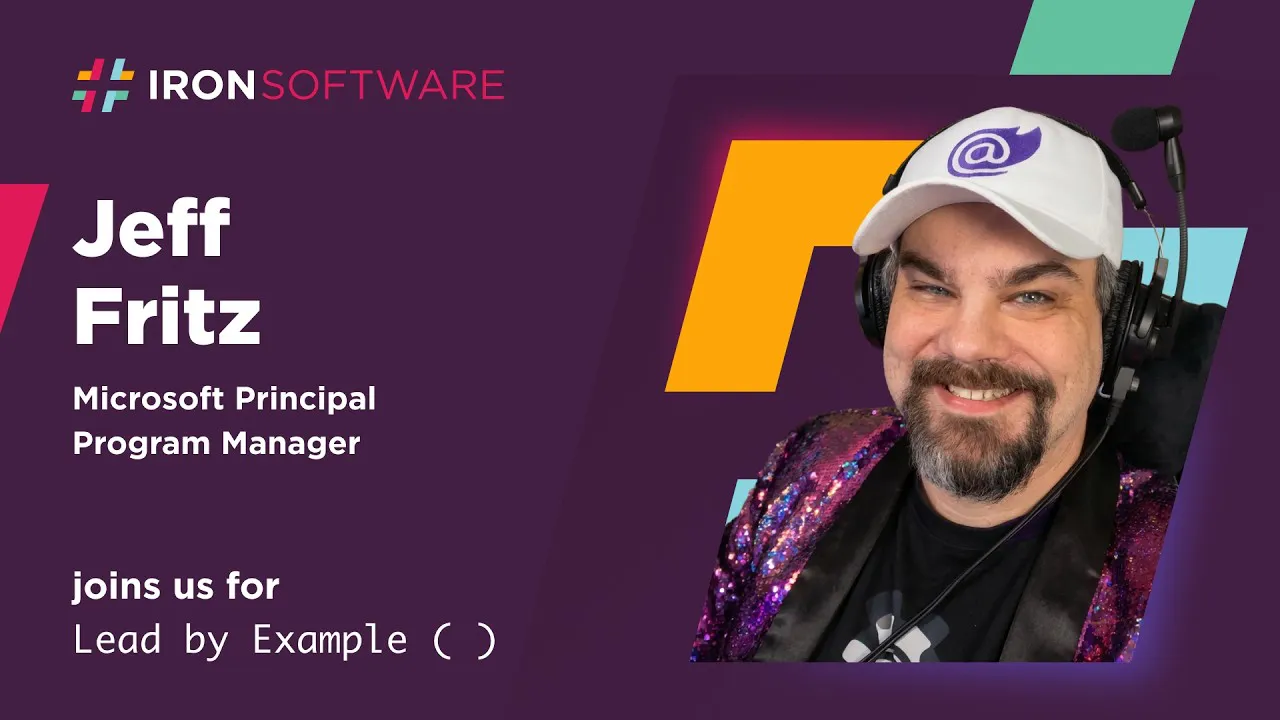
Jeff Fritz spent over a decade as a senior program manager at Microsoft, where he became one of the most recognizable faces in the .NET community. He's known for his live streams, workshops, and conference talks but more than that, he's known for making mistakes on camera and showing developers how to recover. He describes himself as the "relatable guy down the hall" rather than someone who inspires hero worship.
His path to public speaking started at local user groups in Philadelphia, evolved through a game show called Speaker Idol (which he lost, twice), and eventually led to roles at Telerik and Microsoft. Along the way, he's raised funds for St. Jude Children's Research Hospital and the Raspberry Pi Foundation, donated computers to set up learning labs, and made a point of helping anyone who asks without keeping a list of who he won't work with.
Jeff is proof that leadership doesn't require polish. It requires showing up, being human, and extending a hand. That's why he belongs in this series.
LeadByExample() looks beyond titles to focus on the thinking and actions that define leadership. It's about how credible technologists lead through judgment, responsibility, and action. We've featured Scott Hanselman on ethical stewardship. Matt Goldman on shipping under real constraints. Jakub Chodounsky on thinking critically instead of cargo-culting. Kate Kirwin on building opportunity before mastery. Each guest demonstrates that leadership shows up in how you think, decide, and treat responsibility.
In this episode, Jeff shares what real leadership looks like beyond visibility: deliberately building failure into presentations, learning to explain complex topics at the dinner table, the security threats that genuinely scare him, and why saying "yes" to helping people is easier than maintaining a list of who you won't.
Why Jeff Fritz Belongs in This Series
Jeff will tell you straight: he's not the polished speaker people put on a pedestal. "There's almost like a hero worship around some of those folks," he says. "Hey, that's great, more power to them. But while they may look up to those other folks, I'm the guy sitting down the hall."
That positioning isn't false modesty. It's a strategy. Jeff has spent years cultivating approachability as a competitive advantage and in the process, he's articulated something important about what leadership actually requires.
LeadByExample() is a credibility filter, not a celebrity showcase. We feature people who demonstrate substance over status, thinking over trend-following, responsibility over ego. Jeff embodies all of that while proving that the "soft touch" of mentorship matters more than the visibility of leading by example alone.
He learns in public. He fails in public. He helps without keeping score. And he offers a narrative many developers need right now: you don't have to be perfect to be worth following.
What You'll Learn From Jeff
1. Leadership Is More Than Leading by Example
Jeff challenges the common wisdom that visibility equals leadership. "A lot of folks say lead by example and that putting forth and having a good example to show folks is providing leadership. And it's not just Lead by example that is going to provide leadership."
What's missing? The soft touch. The direct discussion. Mentorship.
He points to Steve Jobs, not for the product reveals, but for the storytelling. "He wasn't just giving an example and giving that visibility, but he was doing that soft touch, gentle leading and taking you through the story."
The insight cuts against the content-creator instinct to simply broadcast expertise. Visibility gets attention. Mentorship creates impact.
2. Fail Fast, Fail Publicly, Fail on Purpose
Jeff's signature move, making mistakes on camera and recovering in real time, didn't happen by accident. It evolved from Agile methodology.
"When you're doing scrum, they tell you fail fast. If something isn't working, identify that it's not working. It's okay that it's not working, but identify that quickly so that you can pivot."
He took that principle and built it into his presentations. Literally.
"For a time, I was purposely putting problems in. 'Oh, look, I'm gonna go and build this thing and gosh, see how that doesn't work quite right?' I literally built into my presentation problems."
The result: he got comfortable with failure because he knew it was coming. When he moved to live streams and podcasts, that comfort transferred naturally.
This is the opposite of the polished-speaker playbook. Jeff isn't trying to look infallible. He's trying to be relatable and to show developers that recovery is a skill worth practicing.
3. Relatability Beats Hero Worship
Jeff draws a clear line between two types of technical leaders: the polished performers who inspire awe, and the approachable mentors who inspire action.
"While they may look up to those other folks, I'm the guy sitting down the hall that I'm going to go and be very relatable. Hey, we're going to go out to the local watering hole and grab a beverage after this."
He's explicit that polished speakers serve a purpose. But he also names what's missing: "Beyond that, beyond and below the surface, you don't know anything about those folks because you haven't seen them deal with adversity."
For teams and communities, this matters. You can admire someone from a distance. But you can only learn from someone you trust and trust often comes from seeing how people handle things going wrong.
4. Teach Without Dumbing Down (Practice at the Dinner Table)
Jeff learned to explain complex topics to non-technical audiences at home. His father was a technology leader. His mother was a public school teacher who "doesn't know a thing about what's going on with coding."
"Learning how to talk to and explain to a teacher about those topics without dumbing down, but making something a little bit clearer in explanation, talking about a table and comparing it to a spreadsheet."
He names his influences: Bill Nye. Mr. Wizard. Science communicators who spoke to kids without condescension.
"That's where I aspire to those types of interactions. And being able to practice that with my family and learning from explaining to my mother went a long way to emulating those folks that I aspire to."
The takeaway for technical leaders: find your dinner table. Find the person who will tell you when your explanation doesn't land. Practice until it does.
5. The Only Constant Is Change (So Keep Learning)
Jeff references Glengarry Glen Ross, not for the sales tactics, but for the ABCs. "You need to always be closed. Same thing with the technology field. You need to always be learning."
His practical advice: don't let a decade pass between learning cycles. "Probably should be in at least once every five years. Don't let it go 10 years in between looking at and catching up on things."
He practices what he preaches. "I bought my first 3D printer in December and I've been learning how to build things with it. I'm growing and learning more about working in 3D virtual space."
The frame he offers is playful rather than anxious: "It feels like going into the toy store every week or two and seeing, hey, look at the cool new things that I get to play with."
6. What Actually Scares Him: State Actors and Real Threats
When asked what's scared him in his career, Jeff gets serious.
"When we talk about some of the security problems that happen out there, the advancement of state actors in how our security has evolved around our applications, around our systems that evolution really scares me."
He describes the shift from early-internet pranks to existential threats: "It goes from just being some kids that are trying to do something to goof around and almost graffiti. No, these aren't people who are just being malicious, 'we want to take your money.' These are people from another country that want to see you devastated."
His point isn't fear-mongering. It's a call for vigilance: "That's a whole other level of needing to secure your applications, needing to make sure that you're implementing good coding practices."
7. Help Without Keeping Score
Jeff's clearest leadership principle: say yes to helping people, and don't keep a list of exceptions.
"It's so much easier to say, yes, I'm going to help folks, than saying, no, I'm not going to help and keep some sort of a checklist of, here's the folks that I'm not going to work with."
He names the hidden cost of grudges: "Those folks have that psychic stress on them, that mental stress of, wait a second, am I allowed to work with them? Did they do something I don't like?"
His alternative: "I don't care whether you did something I like or don't like. If you need a helping hand, I'm going to extend a hand and I'm going to get you pointed in a direction that I think is going to make you successful."
This is leadership as subtraction, removing friction, removing ego, removing the mental overhead of tracking who deserves help.
8. What Not to Copy: Impatience Behind Closed Doors
When asked what people should not emulate from his career, Jeff is direct: "Behind closed doors, I can be a little impatient."
"That's something that I work hard on because it can frustrate the heck out of you when you're working on something, you're asking for help on something, and it's taking too long to get done on your timetable."
He's not performing humility. He's naming a real struggle: "I know some days I struggle. But being able to still pay it forward when I need to and when I can, that's where I encourage folks to go."
The honesty matters. Leaders who only show their strengths create an impossible standard. Leaders who name their weaknesses create permission for others to grow.
9. Charity as Legacy: St. Jude and Raspberry Pi
Jeff has raised funds through live streams, run charity fundraisers, and donated Raspberry Pi computers to set up learning labs at St. Jude Children's Research Hospital.
He gets emotional talking about it. "Each time that I hear that a kid has stepped out of the hospital and they beat cancer, they beat leukemia as a father of two daughters, I love to hear that. It brings a tear to my eye."
He also names the harder moments: two young boys he met through his St. Jude work whose cancer went into remission and then came back. "To learn in spring of 2025 that they lost their fight... It was heart-wrenching."
His message to technologists: "We have those resources. We have the time. We have amazing talents. And we're getting paid a lot of money. To be able to take and give just a little bit of that to an organization that's going to make that go a long way to help kids beat cancer... it's simply a must."
10. The Speaker Idol Story: Losing Twice, Getting Hired Twice
Jeff's origin story in public speaking is a lesson in persistence and in how failure creates opportunity.
He entered Speaker Idol at Microsoft's TechEd conference in 2012. It was a game show: five-minute presentations, a panel of judges, winner gets to speak at TechEd the next year.
Day one: he lost. Came in second. But he was invited back as a wild card on day four and lost again.
"And that's okay, because it was 2012 and two of the judges that were in the audience were two vice presidents from Telerik. And they said to me, 'You speak really good about the product here. I'd love to interview you for a job.'"
He got the job. The next year, he entered Speaker Idol again. Won his heat. Made the finals. Delivered a flawless presentation.
Then the next speaker forgot to plug in their laptop. The low-battery warning popped up mid-presentation. The judges loved how they recovered.
Jeff lost again.
"So I walked away from that event, and gosh, I came in second place. And Scott Hunter says, 'Why don't you come to lunch with me?' And he says, 'You do a really nice job talking about my products. Why don't you come work for me?' And then I got hired at Microsoft."
Two losses. Two jobs. "So I want to go twice and get hired twice."
Why This Conversation Matters Right Now
Jeff keeps returning to a simple frame: leadership isn't visibility. It's the soft touch. It's mentorship. It's helping without keeping score.
His presence in this series matters because he offers a model many developers can actually follow. You don't need to be polished. You don't need to be infallible. You need to show up, fail publicly, recover gracefully, and extend a hand.
He also offers a message that feels especially relevant as the industry accelerates: "The only constant in this industry is change. There's constantly evolution."
The response isn't anxiety. It's curiosity. It's walking into the toy store every week to see what's new.
"I know that in the future at some point Fritz's grandchildren, great-grandchildren are gonna find YouTube videos with great-grandpa sitting behind a camera here with a rainbow beard, wearing a chicken costume, and talking about giving money to kids who have cancer. And they're gonna learn all about Granddad."
That's legacy. Not the metrics. The moments.
Watch the Episode
LeadByExample() isn't about buzzwords. It's about leaders doing the work: building teams, building communities, and building the conditions for more people to succeed.
Watch Jeff Fritz's episode, and subscribe for upcoming conversations with the builders, mentors, advocates, and engineers shaping what leadership in tech looks like now.




 Get started for FREE
 Get started for FREE
 Book Free Live Demo



 No credit card or account creation required