Leer archivos Excel en ASP.NET MVC usando C# con IronXL

IronXL permite a los desarrolladores de ASP.NET MVC leer archivos de Excel directamente en C# sin dependencias de Microsoft Office, convirtiendo los datos de Excel a System.Data.DataTable para una fácil visualización en vistas web con solo unas pocas líneas de código.
Este ejemplo muestra cómo comenzar en segundos: carga un libro de Excel, selecciona la primera hoja de trabajo y conviértelo a un System.Data.DataTable usando IronXL - sin Interop, sin complicaciones.
-
1Install IronXL with NuGet Package Manager
-
2Copie y ejecute este fragmento de código.
var dataTable = IronXL.WorkBook.Load("CustomerData.xlsx").DefaultWorkSheet.ToDataTable(true);Dim dataTable = WorkBook.Load("CustomerData.xlsx").DefaultWorkSheet.ToDataTable(True) -
3Despliegue para probar en su entorno real
Comienza a usar IronXL en tu proyecto hoy mismo con una prueba gratuita
Flujo de trabajo mínimo (5 pasos)
- Instalar la biblioteca C# para leer archivos de Excel en ASP.NET
- Cargar y acceder a la hoja objetivo en el archivo Excel
- Acceda al método
ToDataTabley devuélvalo aView - Mostrar datos de Excel en una página web mediante un bucle
- Recorre todos los datos y construye una tabla HTML
¿Cómo crear un proyecto ASP.NET para leer en Excel?
¿Por qué Visual Studio 2022 funciona mejor para esto?
Con Visual Studio 2022, cree un nuevo proyecto ASP.NET. Visual Studio 2022 proporciona excelente soporte para los marcos .NET 6+, mejor IntelliSense para métodos de IronXL, y mejor rendimiento al trabajar con archivos de Excel grandes. La integración de NuGet del IDE hace que la instalación de IronXL sea particularmente sencilla.
¿Qué plantilla de proyecto debo elegir?
Para leer archivos Excel en ASP.NET, elija la plantilla "ASP.NET Core Web App (Model-View-Controller)". Esta plantilla ofrece una estructura MVC limpia que separa el procesamiento de datos (lectura de Excel) de la lógica de presentación. El patrón MVC funciona perfectamente con la conversión de IronXL's DataTable, permitiendo cargar hojas de cálculo en controladores y mostrarlas en vistas sin problemas.
¿Qué versión de .NET se recomienda?
IronXL funciona con .NET Framework 4.6.2+ y .NET Core 3.1+. Para los nuevos proyectos ASP.NET MVC, utilice .NET 6.0 o superior para obtener un rendimiento y una seguridad óptimos. Estas versiones ofrecen una mejor gestión de la memoria al procesar grandes archivos de Excel y un mejor soporte async/await para convertir tipos de archivos de hojas de cálculo.
¿Cómo instalo la biblioteca IronXL?
¿Cuáles son los requisitos de instalación?
¿Qué método de instalación es más rápido?
Después de crear el nuevo proyecto, instale la biblioteca IronXL. Siga estos pasos para instalar IronXL. Abre la Consola del Administrador de Paquetes NuGet y ejecuta el siguiente comando:
¿Cómo puedo verificar la instalación?
Para verificar que IronXL esté correctamente instalado, revise las dependencias de su proyecto en el Explorador de Soluciones. Debería ver "IronXL" en la lista de "Dependencias > Paquetes". Además, intente agregar using IronXL; en la parte superior de su archivo de controlador - IntelliSense debería reconocer el espacio de nombres de inmediato. Para solucionar problemas de instalación, visite la guía de licencias.
¿Cómo leo un archivo Excel en mi controlador?
¿Qué código va en la acción del controlador?
Abra el controlador predeterminado en su proyecto ASP.NET (por ejemplo, HomeController.cs) y reemplace el método Index con el siguiente código:
using IronXL;
using System.Data;

public ActionResult Index()
{
    // Load the Excel workbook from a specified path.
    WorkBook workBook = WorkBook.Load(@"C:\Files\Customer Data.xlsx");

    // Access the first worksheet from the workbook.
    WorkSheet workSheet = workBook.WorkSheets.First();

    // Convert the worksheet data to a DataTable object.
    // The 'true' parameter uses the first row as column headers
    var dataTable = workSheet.ToDataTable(true);

    // Send the DataTable to the view for rendering.
    return View(dataTable);
}Imports IronXL
Imports System.Data
Public Function Index() As ActionResult
' Load the Excel workbook from a specified path.
Dim workBook As WorkBook = WorkBook.Load("C:\Files\Customer Data.xlsx")
' Access the first worksheet from the workbook.
Dim workSheet As WorkSheet = workBook.WorkSheets.First()
' Convert the worksheet data to a DataTable object.
' The 'true' parameter uses the first row as column headers
Dim dataTable = workSheet.ToDataTable(True)
' Send the DataTable to the view for rendering.
Return View(dataTable)
End Function¿Por qué usar DataTable en lugar de otros formatos?
En el método de acción Index, cargue el archivo de Excel usando el método IronXL de Load. La ruta del archivo Excel (incluyendo el nombre del archivo) se proporciona como un parámetro a la llamada del método. Luego, seleccione la primera hoja de Excel como la hoja de trabajo y cargue los datos contenidos en ella en un objeto DataTable. Finalmente, envíe el DataTable al frontend.
DataTable es ideal para ASP.NET MVC porque se integra sin problemas con las vistas Razor y proporciona soporte incorporado para iterar a través de filas y columnas. A diferencia de los objetos personalizados, DataTable no requiere mapeo de modelos y maneja tipos de datos mixtos automáticamente. También puede exportar DataSet y DataTable de nuevo a Excel cuando sea necesario.
¿Qué pasa con la gestión de errores de los archivos que faltan?
La gestión de errores garantiza que la aplicación no se bloquee si faltan archivos de Excel o están dañados. Aquí tienes una versión mejorada con un tratamiento adecuado de las excepciones:
public ActionResult Index()
{
    try
    {
        string filePath = @"C:\Files\Customer Data.xlsx";

        // Check if file exists before attempting to load
        if (!System.IO.File.Exists(filePath))
        {
            ViewBag.Error = "Excel file not found at specified location.";
            return View(new DataTable());
        }

        // Load workbook with error handling
        WorkBook workBook = WorkBook.Load(filePath);

        // Verify worksheet exists
        if (workBook.WorkSheets.Count == 0)
        {
            ViewBag.Error = "No worksheets found in the Excel file.";
            return View(new DataTable());
        }

        WorkSheet workSheet = workBook.WorkSheets.First();
        var dataTable = workSheet.ToDataTable(true);

        return View(dataTable);
    }
    catch (Exception ex)
    {
        // Log the exception (consider using a logging framework)
        ViewBag.Error = $"Error reading Excel file: {ex.Message}";
        return View(new DataTable());
    }
}Public Function Index() As ActionResult
Try
Dim filePath As String = "C:\Files\Customer Data.xlsx"
' Check if file exists before attempting to load
If Not System.IO.File.Exists(filePath) Then
ViewBag.Error = "Excel file not found at specified location."
Return View(New DataTable())
End If
' Load workbook with error handling
Dim workBook As WorkBook = WorkBook.Load(filePath)
' Verify worksheet exists
If workBook.WorkSheets.Count = 0 Then
ViewBag.Error = "No worksheets found in the Excel file."
Return View(New DataTable())
End If
Dim workSheet As WorkSheet = workBook.WorkSheets.First()
Dim dataTable = workSheet.ToDataTable(True)
Return View(dataTable)
Catch ex As Exception
' Log the exception (consider using a logging framework)
ViewBag.Error = $"Error reading Excel file: {ex.Message}"
Return View(New DataTable())
End Try
End Function¿Cómo puedo seleccionar diferentes hojas de cálculo?
IronXL proporciona múltiples maneras de seleccionar y trabajar con hojas de trabajo específicas. Puede acceder a las hojas de cálculo por índice, nombre o iterar por todas las hojas disponibles:
// Method 1: Select by worksheet name
WorkSheet namedSheet = workBook.GetWorkSheet("Sales Data");

// Method 2: Select by index (zero-based)
WorkSheet secondSheet = workBook.WorkSheets[1];

// Method 3: Select the default/active worksheet
WorkSheet defaultSheet = workBook.DefaultWorkSheet;

// Method 4: Iterate through all worksheets
foreach (WorkSheet sheet in workBook.WorkSheets)
{
    string sheetName = sheet.Name;
    // Process each worksheet
}' Method 1: Select by worksheet name
Dim namedSheet As WorkSheet = workBook.GetWorkSheet("Sales Data")
' Method 2: Select by index (zero-based)
Dim secondSheet As WorkSheet = workBook.WorkSheets(1)
' Method 3: Select the default/active worksheet
Dim defaultSheet As WorkSheet = workBook.DefaultWorkSheet
' Method 4: Iterate through all worksheets
For Each sheet As WorkSheet In workBook.WorkSheets
Dim sheetName As String = sheet.Name
' Process each worksheet
Next¿Cómo mostrar datos de Excel en una página web?
¿Qué código de vista se necesita?
El siguiente ejemplo muestra cómo mostrar el DataTable devuelto en el ejemplo anterior en un navegador web.
A continuación se muestra el archivo Excel de trabajo utilizado en este ejemplo:
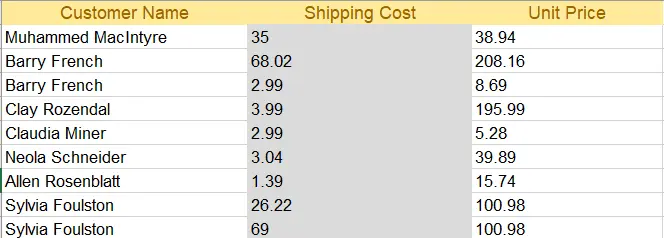
Archivo de Excel
Abra la index.cshtml (vista de índice) y reemplace el código con el siguiente código HTML:
@{
    ViewData["Title"] = "Home Page";
}

@using System.Data
@model DataTable

<div class="text-center">
    <h1 class="display-4">Welcome to IronXL Read Excel MVC</h1>
</div>

@* Check for errors first *@
@if (ViewBag.Error != null)
{
    <div class="alert alert-danger">
        @ViewBag.Error
    </div>
}

@* Display table only if data exists *@
@if (Model != null && Model.Rows.Count > 0)
{
    <table class="table table-dark">
        <tbody>
            @foreach (DataRow row in Model.Rows)
            {
                <tr>
                    @for (int i = 0; i < Model.Columns.Count; i++)
                    {
                        <td>@row[i]</td>
                    }
                </tr>
            }
        </tbody>
    </table>
}
else
{
    <p>No data to display.</p>
}¿Por qué usar Bootstrap para el diseño de tablas?
El código anterior utiliza el DataTable devuelto del método Index como modelo. Cada fila de la tabla se imprime en la página web usando un bucle @for, incluyendo el formato de Bootstrap para la decoración.
Bootstrap ofrece diseños de tablas adaptables que se ajustan automáticamente a distintos tamaños de pantalla, algo crucial para las aplicaciones web modernas. La clase table-dark crea una tabla temática oscura atractiva y fácil de leer. Para un formato más avanzado de Excel como bordes y alineación de celdas o patrones de fondo y colores, IronXL proporciona métodos adicionales para acceder a datos estructurados directamente.
¿Cómo es el resultado final?
Al ejecutar el proyecto se obtienen los resultados que se muestran a continuación:
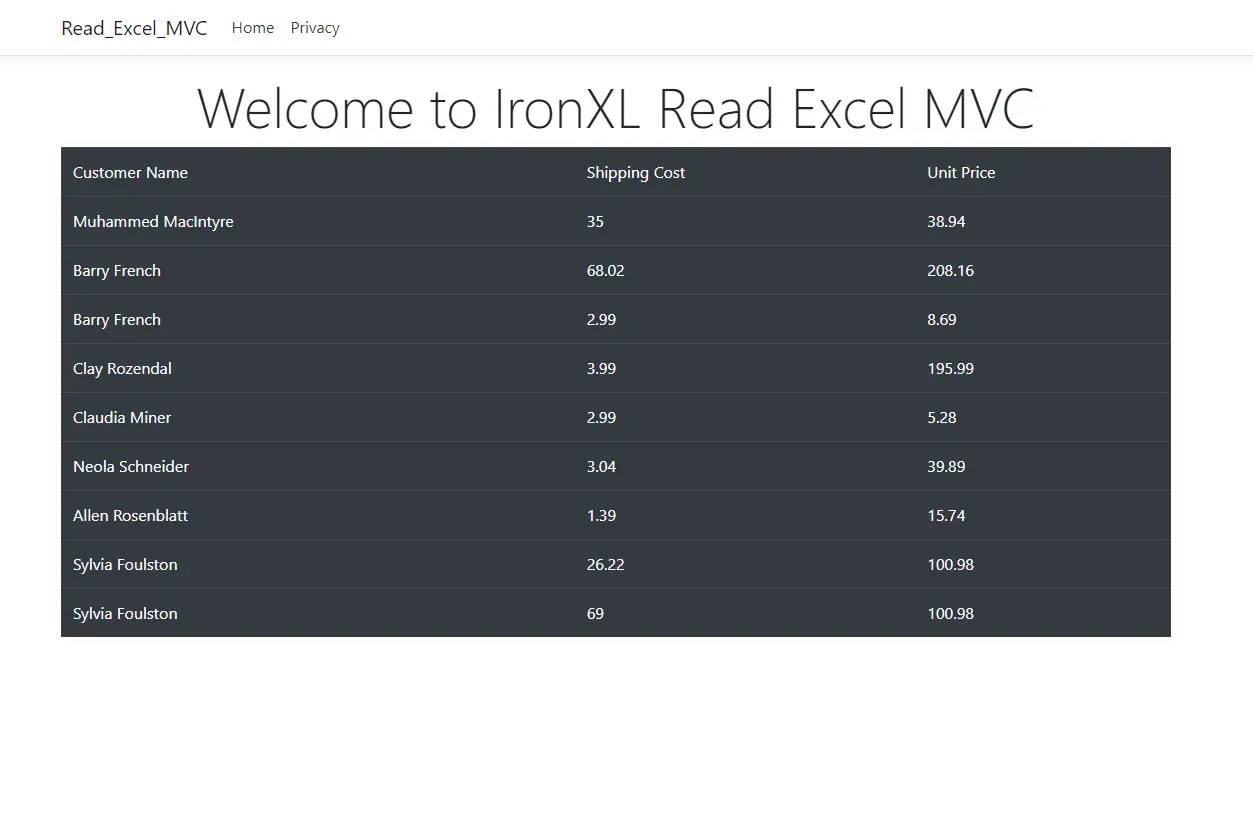
Tabla Bootstrap
¿Cómo puedo añadir encabezados a la tabla?
Para mostrar los encabezados de columna de su archivo Excel, modifique el código de la vista para incluir una sección de encabezado de tabla. Al llamar a ToDataTable(true), IronXL utiliza automáticamente la primera fila como nombres de columnas:
@if (Model != null && Model.Rows.Count > 0)
{
    <table class="table table-dark">
        <thead>
            <tr>
                @foreach (DataColumn column in Model.Columns)
                {
                    <th>@column.ColumnName</th>
                }
            </tr>
        </thead>
        <tbody>
            @foreach (DataRow row in Model.Rows)
            {
                <tr>
                    @for (int i = 0; i < Model.Columns.Count; i++)
                    {
                        <td>@row[i]</td>
                    }
                </tr>
            }
        </tbody>
    </table>
}netEsta mejora muestra encabezados de columna adecuados como "Nombre del cliente", "Costo de envío", y "Precio unitario" de su archivo de Excel. Para escenarios más complejos que involucren rangos nombrados o tablas nombradas, IronXL proporciona métodos adicionales para acceder a datos estructurados directamente.
Preguntas Frecuentes
¿Cómo puedo leer archivos Excel en ASP.NET MVC sin Microsoft Office?
IronXL le permite leer archivos de Excel directamente en C# sin ninguna dependencia de Microsoft Office. Simplemente instale IronXL a través de NuGet, luego utilice WorkBook.Load() para abrir su archivo de Excel y convertirlo en una DataTable con sólo una línea de código: var dataTable = IronXL.WorkBook.Load('CustomerData.xlsx').DefaultWorkSheet.ToDataTable(true);
¿Cuál es la forma más rápida de convertir datos de Excel a DataTable en ASP.NET?
IronXL proporciona el método ToDataTable() que convierte instantáneamente las hojas de cálculo de Excel en objetos System.Data.DataTable. Después de cargar su libro de trabajo con IronXL, acceda a cualquier hoja de cálculo y llame a ToDataTable(true) para incluir los encabezados. Esta conversión sólo requiere una línea de código y funciona perfectamente con las vistas MVC de ASP.NET.
¿Qué versión de .NET debo utilizar para el procesamiento de archivos Excel en aplicaciones web?
IronXL es compatible con .NET Framework 4.6.2+ y .NET Core 3.1+. Para los nuevos proyectos ASP.NET MVC, se recomienda .NET 6.0 o superior, ya que ofrece una mejor gestión de la memoria al procesar grandes archivos de Excel con IronXL y un mejor soporte async/await para las operaciones de hoja de cálculo.
¿Qué plantilla de proyecto de Visual Studio funciona mejor para la funcionalidad de lectura de Excel?
Elija la plantilla 'ASP.NET Core Web App (Model-View-Controller)' al crear su proyecto. Esta estructura MVC complementa perfectamente la función de conversión DataTable de IronXL, lo que le permite cargar y procesar archivos de Excel en controladores mientras muestra los datos limpiamente en vistas.
¿Cómo instalo la biblioteca de lectura de Excel en mi proyecto ASP.NET?
Instale IronXL a través de la consola del administrador de paquetes NuGet ejecutando 'Install-Package IronXL.Excel'. Después de la instalación, verifica que se ha añadido correctamente comprobando las dependencias de tu proyecto y añadiendo 'using IronXL;' a tu controlador - IntelliSense debería reconocer el espacio de nombres inmediatamente.
Why choose DataTable format when using IronXL?
The DataTable format is ideal for ASP.NET MVC applications because it integrates with Razor views, allows for straightforward iteration over data rows and columns without model mapping, and accommodates mixed data types efficiently.
What steps are required to install IronXL in an ASP.NET MVC project?
Installation involves adding IronXL via the NuGet Package Manager in Visual Studio. It requires opening the NuGet Package Manager Console and executing a specific command to add IronXL to the project's dependencies.
How do you handle errors when reading Excel files with IronXL?
IronXL supports reliable error handling such as checking file existence before loading, catching exceptions during the workbook loading process, and managing missing worksheet scenarios. This ensures application stability even if Excel files are corrupted or absent.
Can IronXL select specific worksheets from an Excel file?
Yes, IronXL allows developers to select worksheets by name, index, or default setting, and it also provides functionality to iterate through all available worksheets in a workbook.
What are some styling options for displaying Excel data using IronXL in web apps?
IronXL, when used with ASP.NET MVC, enables styling options like Bootstrap for responsive table layouts and additional IronXL methods for setting cell borders, alignment, patterns, and colors within spreadsheets.

Curtis Chau tiene una licenciatura en Ciencias de la Computación (Carleton University) y se especializa en el desarrollo front-end con experiencia en Node.js, TypeScript, JavaScript y React. Apasionado por crear interfaces de usuario intuitivas y estéticamente agradables, disfruta trabajando con frameworks modernos y creando manuales bien estructurados y visualmente atractivos.